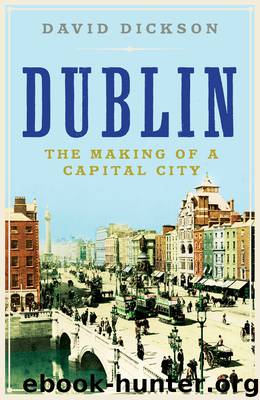
Dublin: The Making of a Capital City by David Dickson
Author:David Dickson [Dickson, David]
Language: eng
Format: epub
Tags: History, Europe, Ireland
ISBN: 9780674745049
Google: aeJXBQAAQBAJ
Amazon: 0674744446
Goodreads: 21981527
Publisher: Harvard University Press
Published: 2014-11-17T00:00:00+00:00
The hub of news
The political excitements of the 1880s transformed newspaper sales, and the greatest beneficiary in the short term was the venerable Freeman’s Journal, even though United Ireland had taken greater risks and suffered greater official harassment. Earlier in the century Dublin’s papers, conservative and independent, had lost ground to English rivals, and the nationalist press had fragmented. Things began to change after the abolition of stamp duty in 1855; four Dublin daily papers took the plunge and slashed their prices to a penny an issue in 1859, including the Freeman’s Journal and a new conservative business paper, The Irish Times, in hopes both of increased provincial circulation and advertising revenue. Gradually this paid off. After the 1850s, wholesale newspaper distributors, exploiting the trunk railway network, managed to get Dublin papers onto provincial news-stands every morning ahead of the post. The Abbey Street warehouse of W. H. Smith, the pioneer wholesale newsagents in both islands, was a hive of activity from 5 a.m. each day.13
Dublin’s role as Irish news hub was enhanced by the revolution in telecommunications beginning with the establishment of telegraphic transmission with London, operational via the North Channel link from 1853, and this Morse-linked web was dramatically extended in 1866 with the opening of a successful transatlantic cable via Valentia Island, meaning that news from America could now reach Dublin as quickly as London. As the cost of electric telegraphy fell in the 1860s, its crucial role in the transmission of commercial information was established. By the 1890s there were thirty-five telegraph offices in the city from which telegrams could be despatched worldwide, most of them open twelve hours a day, with the Cattle Market service the first to open at 6 a.m. That said, it was the seamless operation of the postal service, which remained vital to the functioning of the urban economy, evident since the dramatic fall in postal costs in 1840 with the coming of the UK-wide penny postal service. This was crucial to the growth of firms like the Stewart and Kincaid, the first Dublin land agency to provide management services to a nationwide portfolio of landed estates. Postal volumes grew exponentially in the following decades. By the late nineteenth century there were six postal deliveries every weekday in the city, five in the suburbs. The speed at which transatlantic mail reached the city via Queenstown was a constant issue, and Dublin’s slight advantage here over Liverpool occasionally counted.
Telephone communication came to Dublin c.1880. The first primitive exchange was located in the Commercial Buildings, and once a link with Belfast was established commercial interest developed quickly. By 1888 there were some 700 telephones in the city. Voice quality was very poor, but the technology inaugurated a subtle change in the character, first of commercial, then social, communication. A telephone link to London (via Scotland) was established in 1893, but it was only after the opening of the Crown Alley exchange in 1900 and the introduction of a direct and robust cross-channel link in 1913 that telegraphy was fully eclipsed by the telephone.
Download
This site does not store any files on its server. We only index and link to content provided by other sites. Please contact the content providers to delete copyright contents if any and email us, we'll remove relevant links or contents immediately.
| Africa | Americas |
| Arctic & Antarctica | Asia |
| Australia & Oceania | Europe |
| Middle East | Russia |
| United States | World |
| Ancient Civilizations | Military |
| Historical Study & Educational Resources |
Room 212 by Kate Stewart(5130)
The Crown by Robert Lacey(4820)
Endurance: Shackleton's Incredible Voyage by Alfred Lansing(4788)
The Iron Duke by The Iron Duke(4367)
The Rape of Nanking by Iris Chang(4224)
Joan of Arc by Mary Gordon(4117)
Killing England by Bill O'Reilly(4008)
Say Nothing by Patrick Radden Keefe(3991)
I'll Give You the Sun by Jandy Nelson(3451)
Shadow of Night by Deborah Harkness(3377)
Hitler's Monsters by Eric Kurlander(3348)
Mary, Queen of Scots, and the Murder of Lord Darnley by Alison Weir(3215)
Blood and Sand by Alex Von Tunzelmann(3207)
Eleanor & Park by Rainbow Rowell(3185)
Darkest Hour by Anthony McCarten(3135)
Margaret Thatcher: The Autobiography by Thatcher Margaret(3087)
Book of Life by Deborah Harkness(2943)
Red Famine: Stalin's War on Ukraine by Anne Applebaum(2940)
The One Memory of Flora Banks by Emily Barr(2870)
